


A choice between 1144 Stress Proof vs. Fatigue-Proof steel bar should follow the shaft’s load spectrum, geometry, machining sequence, and required mechanical properties. Both products are associated with high-strength, free-machining shaft applications, but the names do not describe identical performance. At O’Hare Precision Metals, we review the drawing and service conditions before connecting either bar to a precision grinding or cut-length requirement.
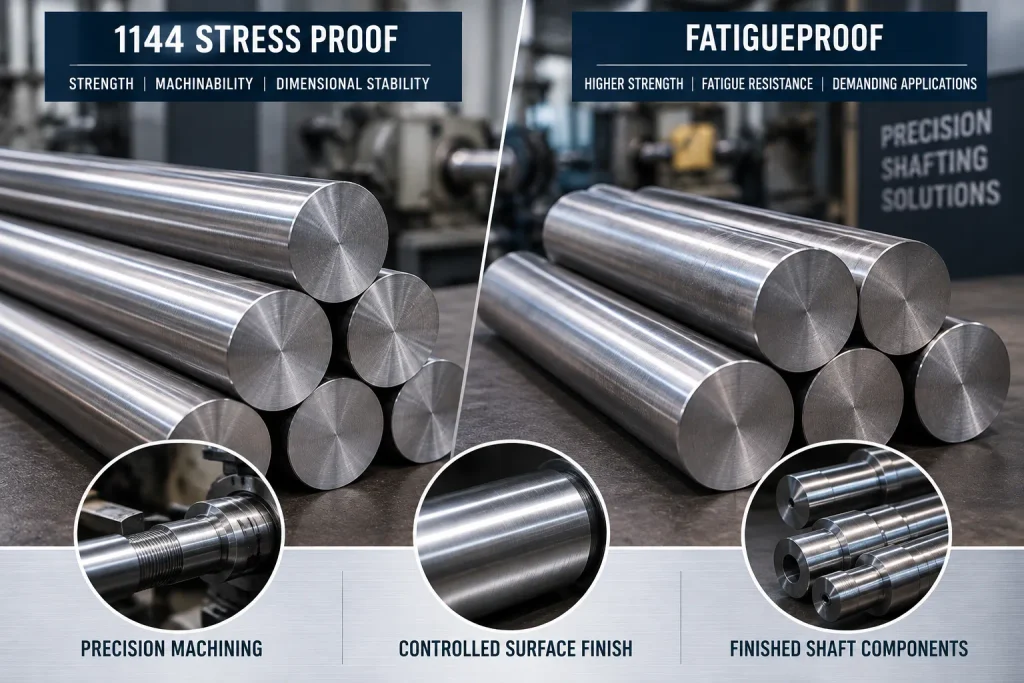
Stress Proof is commonly selected for strength, machinability, and dimensional stability after material removal. Fatigue-Proof is positioned for higher mechanical strength and fatigue-demanding components. We supply 1144 Stress Proof steel and Fatigueproof carbon bar stock as separate material options with different performance characteristics.
What Is the Core Difference for Shaft Designers?
The dominant difference is whether general strength and stable machining or repeated-load resistance controls the decision.
1144 Stress Proof Supports Stable, Efficient Machining
1144 Stress Proof is based on a resulfurized medium-carbon steel chemistry and controlled processing intended to provide high strength in the as-supplied condition. It is widely considered for pins, rods, arbors, bushings, and shafts where machinability and reduced distortion after machining are valuable.
Stress Relief Does Not Eliminate Every Distortion Risk
Residual stress can still be influenced by bar size, straightening, grinding, asymmetric stock removal, heat from machining, and part geometry. Thin walls, deep keyways, long unsupported lengths, and heavy one-sided cuts can release stress unevenly. A stable bar helps, but the machining plan must remain balanced.
Fatigue-Proof Targets Repeated-Load Performance
Fatigue-Proof carbon bar is produced for a higher-strength performance range and is used for components such as bolts, pins, and tie rods. Fatigue-Proof Carbon Bar Stock is listed with 140,000 psi tensile strength, 125,000 psi yield strength, 5 percent elongation, 15 percent reduction of area, and 280 Brinell hardness. Actual material requirements should be confirmed against the applicable order specification and supplied material documentation.
Product Names Must Be Procured Precisely
Stress Proof and Fatigueproof are separate product designations and should not be treated as interchangeable names for standard 1144 bar. State the exact designation, producer requirement if applicable, specification, size, and condition. If an alternative is proposed, engineering approval should be documented before purchase.
How Strength, Fatigue, and Machinability Affect the Choice
The correct comparison separates static load, cyclic load, manufacturing behavior, and final geometry.
Static Strength Is Only One Shaft Requirement
Yield strength helps indicate when permanent deformation begins under a simple loading condition. Tensile strength describes maximum engineering stress in a tensile test. A shaft design may also be controlled by torsion, bending, stress concentration, impact, buckling, or surface condition. We therefore avoid selecting a bar from one strength value alone.
Fatigue Depends on the Finished Component
Repeated bending or torsion can initiate cracks at keyways, shoulders, threads, grooves, inclusions, or damaged surfaces. Material strength contributes to fatigue performance, but the stress range, mean stress, notch geometry, size, surface finish, residual stress, environment, and heat history all matter. Fatigue-Proof may be the stronger starting point for cyclic duty, yet the designer must evaluate the finished shaft.
Machinability Affects Cost and Dimensional Control
Both product families are chosen partly for machining efficiency compared with many heat-treated alloy steels. Tool geometry, rigidity, cutting speed, feed, coolant, chip control, and hardness still affect results. We also supply carbon round bar in multiple grades for machining and manufacturing applications.
Why Bar Geometry Matters Before Shaft Machining
Material properties cannot compensate for incorrect diameter, bow, roundness, or surface allowance.
Centerless Grinding Establishes a Controlled Starting Surface
Ground bar can reduce the amount of stock that must be removed and provide a consistent outside diameter for collets, bushings, or bar-fed equipment. We provide centerless grinding for applications that require controlled diameter and surface finish.
Straightness Should Match Length and Operation
A short pin and a long transmission shaft do not need the same straightness language. State the permitted deviation and gauge length, plus any total-length requirement. Long, slender bars may also need controlled support during inspection, machining, and shipping.
Surface Finish Can Influence Fatigue Initiation
Grinding marks, tool marks, scratches, and abrupt transitions can become stress raisers when they align unfavorably with cyclic loading. The drawing should specify the finish on critical journals or fillets and identify any directionality requirement. Do not rely on a general statement that a bar is smooth.
How to Choose Between Stress Proof and Fatigue-Proof
Choose 1144 Stress Proof when the application prioritizes good machinability, high as-supplied strength, and dimensional stability for a shaft under moderate, well-characterized loading. Choose Fatigue-Proof when the part has a more demanding cyclic-load requirement and its higher published property range aligns with the design analysis.
At O’Hare Precision Metals, we recommend comparing both options against the same drawing attributes: product designation, diameter, length, strength requirements, hardness, straightness, surface finish, critical features, quantity, and certification. O’Hare Precision Metals is ISO 9001:2015 certified.
Submit your grade, diameter, length, quantity, processing requirements, and drawing to request a quote. We can then review the bar and processing scope without replacing the design engineer’s material decision.
Frequently Asked Questions
Is Fatigue-Proof simply another name for 1144 Stress Proof?
No. They are separate product designations with different intended performance profiles. The purchase order should identify the exact product required and should not permit substitution without approval.
Which material machines more easily?
Both are designed with machinability in mind, but actual performance depends on hardness, size, condition, tooling, setup, and operation. A controlled trial may be appropriate for a new production process.
Does higher tensile strength guarantee longer fatigue life?
No. Fatigue life also depends on stress range, notches, surface finish, size, residual stress, environment, and component geometry. Use the finished-part design analysis.
Can these bars be welded into a shaft assembly?
Weldability must be evaluated carefully because chemistry, strength level, heat input, joint restraint, and required post-weld properties matter. Follow a qualified procedure and obtain engineering approval.
What should appear on the RFQ?
Include the exact product designation, specification, grade, condition, diameter, tolerance, straightness, finish, length, quantity, mechanical-property requirements, heat traceability, MTR, and any additional inspection.