


The choice between 321 and 347 stainless steel round bar begins with the temperature cycle, fabrication route, and governing specification. Both are stabilized austenitic stainless grades designed to resist sensitization during elevated-temperature exposure. Grade 321 uses titanium stabilization, while 347 uses niobium stabilization. At O’Hare Precision Metals, we help buyers connect that metallurgical difference to the actual bar condition, machining plan, weld exposure, and service requirement.
Neither grade should be selected from temperature alone. The drawing should identify the required specification, product form, condition, diameter, tolerance, finish, and certification. We supply 321 stainless steel bar and 347 stainless steel round bar for applications that require stabilized austenitic stainless grades.
Why Are 321 and 347 Called Stabilized Stainless Steels?
Stabilization changes how carbon is controlled during heating and cooling through the sensitization range.
Grade 321 Uses Titanium Stabilization
Titanium preferentially combines with carbon, which helps reduce chromium-carbide precipitation at grain boundaries during elevated-temperature exposure. This supports resistance to intergranular corrosion after heating when the grade is properly specified and processed.
Fabrication History Still Matters
Stabilization does not make every heat-affected condition harmless. Welding procedure, section size, time at temperature, cooling history, surface condition, and the corrosive medium still affect performance. Buyers should state whether the bar will be welded, hot formed, machined, or repeatedly cycled in service.
Grade 347 Uses Niobium Stabilization
Niobium performs a similar carbon-stabilizing role and is commonly considered when high-temperature exposure also raises creep and stress-rupture concerns. Grade 347 is used in elevated temperature applications, including exposure in the 800°F to 1500°F range, with oxidation resistance noted up to 1500°F.
Stabilizer Choice Is Not the Only Difference
The stabilizing element can affect processing and high-temperature behavior, yet purchased condition, heat treatment, specification limits, bar size, and supplier documentation can be equally important. A grade name without these attributes is not a complete procurement requirement.
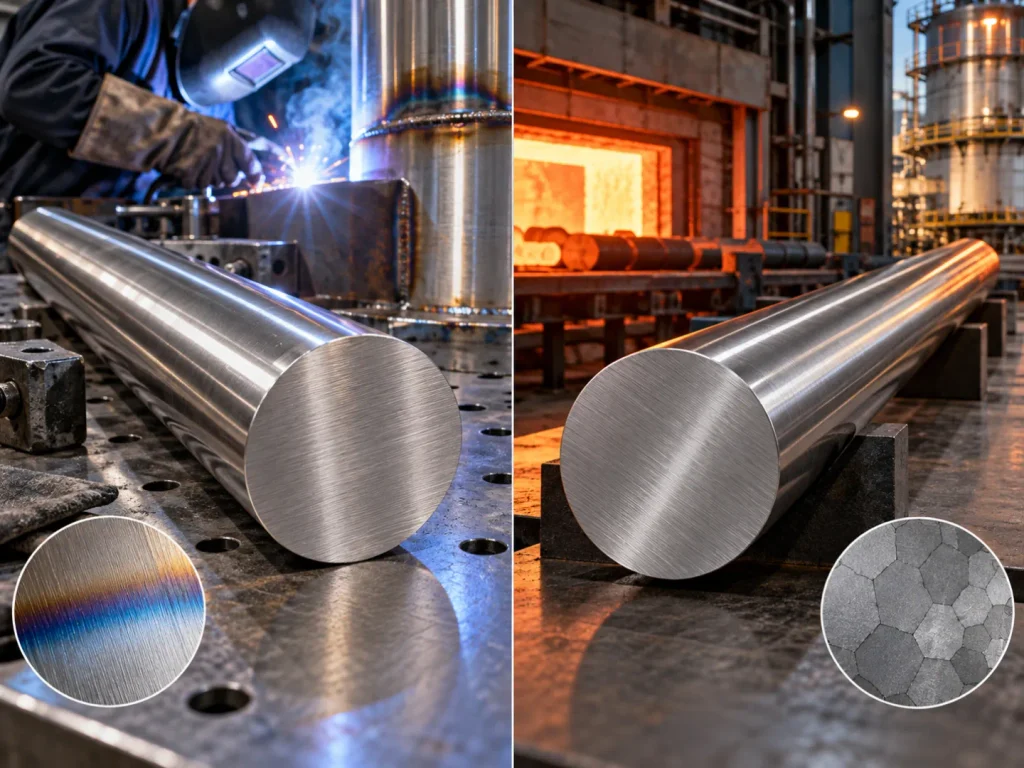
How Do High-Temperature Requirements Change the Choice?
The best comparison uses the same service predicates for both grades: peak temperature, continuous temperature, cycle frequency, stress, atmosphere, and fabrication.
Thermal Cycling and Weld Exposure Favor a Stabilized Grade
Both grades are used where welded or heated austenitic stainless components need resistance to intergranular attack. Grade 321 is often selected for fabricated high-temperature components when titanium stabilization matches the design specification. Grade 347 may be favored when the specification calls for niobium stabilization or when sustained elevated-temperature strength is a stronger design consideration.
Creep and Stress Rupture Need Engineering Data
Creep is time-dependent deformation under stress at elevated temperature. Stress rupture concerns the time to failure under a specified load and temperature. Because these properties depend on temperature, stress, heat, size, and condition, we do not treat a general statement about 347 as a design allowable. The engineer should use the applicable code, material specification, and certified property data.
Corrosion Depends on the Actual Environment
Stabilization mainly addresses sensitization-related intergranular corrosion. It does not guarantee resistance to every chloride, acid, oxidizing, reducing, or crevice condition. For broad stainless product selection, buyers can review our stainless steel round stock range, then confirm the medium, concentration, temperature, oxygen level, contaminants, and cleaning cycle.
What Should Machinists and Fabricators Compare?
Machining and welding decisions should be planned before the bar diameter and condition are finalized.
Machining Requires Control of Heat and Work Hardening
Both grades are austenitic stainless steels and can work harden during machining. Rigid setups, positive cutting action, suitable tooling, controlled feeds, and adequate coolant help manage heat and surface integrity. If the bar will be ground before component machining, our centerless grinding service can be evaluated for diameter and finish requirements.
Welding Procedure Must Match Grade and Code
The base grade, filler selection, joint design, heat input, interpass temperature, cleaning method, and inspection plan should follow the qualified welding procedure. Grade 321’s titanium content and grade 347’s niobium content do not remove the need for procedure control. Any post-weld heat treatment or stabilization requirement should be stated rather than assumed.
Surface Condition Can Affect Downstream Results
Scale, embedded contamination, decarburization, and machining damage can interfere with inspection or corrosion performance. State whether the bar needs a ground, polished, or machining-stock surface and identify the final finish requirement separately from the dimensional tolerance.
How to Write a Complete 321 or 347 Round Bar RFQ
A precise RFQ makes the grade decision traceable to service and fabrication needs.
List the grade, governing ASTM or AMS specification when required, product form, condition, nominal diameter, tolerance, straightness, surface finish, cut length, quantity, heat-treatment condition, and documentation. Add the peak and continuous service temperatures, thermal cycles, applied stress context, atmosphere, weld procedure requirements, and corrosion medium when these factors control selection.
At O’Hare Precision Metals, we connect the requested alloy to bar processing and inspection rather than substituting one stabilized grade without approval. O’Hare Precision Metals is ISO 9001:2015 certified, and any project specific certification or inspection requirements should be identified during the quotation process.
Which Stabilized Grade Should You Specify?
Specify 321 when titanium stabilization, fabrication history, and the governing material requirement point to that grade. Specify 347 when niobium stabilization, prolonged elevated-temperature loading, or the governing specification points to 347. If either option could work, compare code allowables, corrosion exposure, weld procedure, availability in the required condition, and total processing route before approval.
We can review the requested diameter, finish, length, condition, and documentation for either grade. Submit the drawing and service details through our request a quote page so we can confirm the product and processing scope.
Frequently Asked Questions
Can 321 and 347 stainless steel be substituted directly?
Not without engineering approval. Their stabilizing elements, specifications, high-temperature properties, fabrication behavior, and availability can differ. Use the grade required by the drawing or governing code.
Is 347 always better than 321 at high temperature?
No single grade is always better. Sustained stress, temperature, thermal cycles, atmosphere, welding, corrosion, and code allowables determine which grade fits the component.
Do both grades resist intergranular corrosion?
Both are stabilized to reduce sensitization-related risk after elevated-temperature exposure. Actual performance still depends on processing history, corrosive environment, surface condition, and specification compliance.
Can 321 or 347 be hardened by heat treatment?
They are austenitic grades and are not hardened like martensitic stainless steels through conventional quench-and-temper treatment. Mechanical properties can change through cold work and other processing.
What documents should be requested with stabilized stainless bar?
State whether the order requires an MTR, heat number traceability, chemistry, mechanical results, heat-treatment condition, specification compliance, or additional inspection reports. Requirements should appear on the purchase order.