


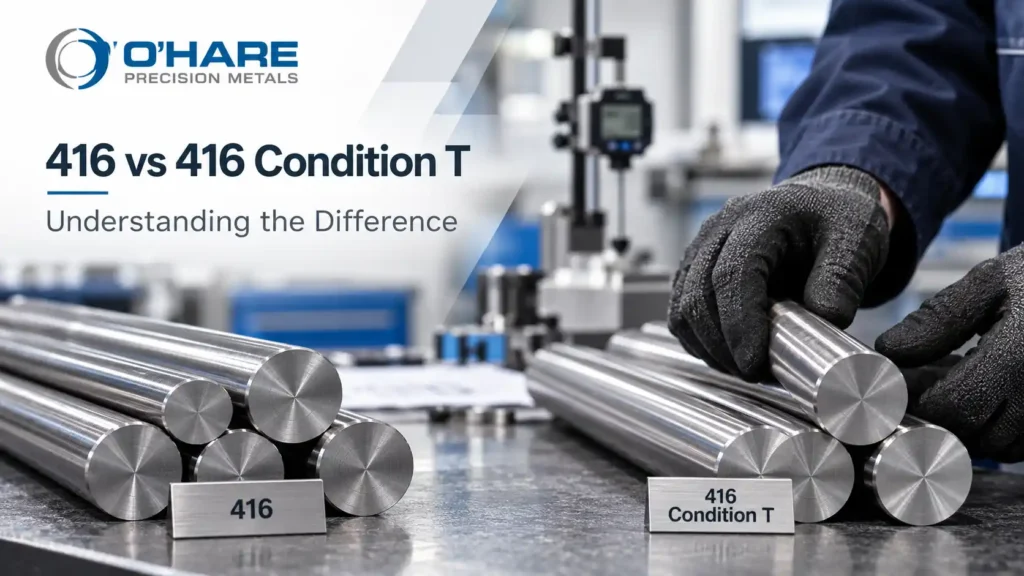
When you’re preparing a purchase order, seeing both 416 and 416 Condition T among our stainless steel options can raise a fair question: which one does your application require? The names are similar, but the difference matters.
At O’Hare Precision Metals, we’ve supplied precision ground and cold finished round bar from the Chicago area since 1970, and 416 is part of our stainless lineup in both forms. Here’s how we’d frame the choice, and where we’d want to see your print before anyone commits.
Comparing 416 Stainless Steel Condition T and Standard 416 Round Bar
Standard 416 stainless steel and 416 Condition T share the same grade designation, but the material condition is an important part of the specification. Understanding that distinction can help you prepare a more accurate material request before ordering.
What standard 416 stainless steel is
Our 416 stainless steel round bar is a martensitic, free machining grade. Both characteristics help explain where it fits among our stainless steel options.
Martensitic places it in the same family as 410 and 420 in our lineup, rather than with austenitic grades like 303, 304, and 316. As a free machining grade, 416 also shares a characteristic with 420F and 430F, the free machining variants of 420 and 430. If your team already knows those grades, that gives you a quick way to place 416 on the map.
What Condition T means on our listing
416 Condition T refers to a specified heat treated condition of 416 stainless steel. Although the underlying alloy grade remains the same, its mechanical properties and supplied condition may differ from other 416 material. Buyers should confirm the applicable material specification and required condition before ordering.
Why the condition belongs on your purchase order
Two bars can share a grade number and still not be interchangeable on your job. If your drawing calls out a condition, that callout needs to travel with the order from engineering to purchasing to us.
It’s an easy detail to lose. The grade gets copied onto the requisition, the condition doesn’t, and nobody notices until the bar is on the machine. If your drawing just says 416, ask your engineer whether a condition was intended before you send the order.
How grinding fits either version
For either material condition, the required dimensions and surface finish should be clearly specified before grinding. Centerless grinding is the core of what we do, and our centerless grinding capabilities include tolerances up to 0.0001 inch and surface finishes of 8 microinches or better, depending on the material and application. We’re ISO 9001:2015 certified, and quality control inspection happens at each phase of our operation. When grade and condition both matter, you want a supplier checking the work at every step, not only at the end.
Work that can happen before the bar ships
A ground bar may be only the first step. We also offer CNC and manual chamfering, turning, polishing, and straightening, and we can package the finished bar to customer preference.
What to put on a 416 quote
Our request a quote form asks for your name, email, phone, company, referral source, and quote information. In the quote field, write the grade and condition exactly as your print shows them, either 416 or 416 Condition T. Then add diameter, length, tolerance, surface finish, quantity, and any secondary work.
Not sure which condition to specify? Include the part requirements and intended application in your quote request.
Let’s settle the condition before the bar is cut
If you’re preparing an order for 416 stainless steel or 416 Condition T, send us your print. Use our request a quote form, call O’Hare Precision Metals at (847) 640-6050, or email sales@ohareprecision.com. We’d much rather sort out the condition on the quote than after the bar is on your machine.
FAQs
What is the difference between 416 and 416 Condition T?
Standard 416 is a martensitic, free machining stainless steel grade, while 416 Condition T is its tempered condition variant. If your part has specific mechanical property requirements, include those details and the required condition when submitting your quote request.
Is 416 a free machining stainless steel?
Yes. 416 is a martensitic stainless steel grade with free machining characteristics.
What should I include in a quote request for 416 bar?
Include the grade, required condition, dimensions, tolerance, surface finish, quantity, and any secondary operations. You can submit these details through our request a quote form.
