


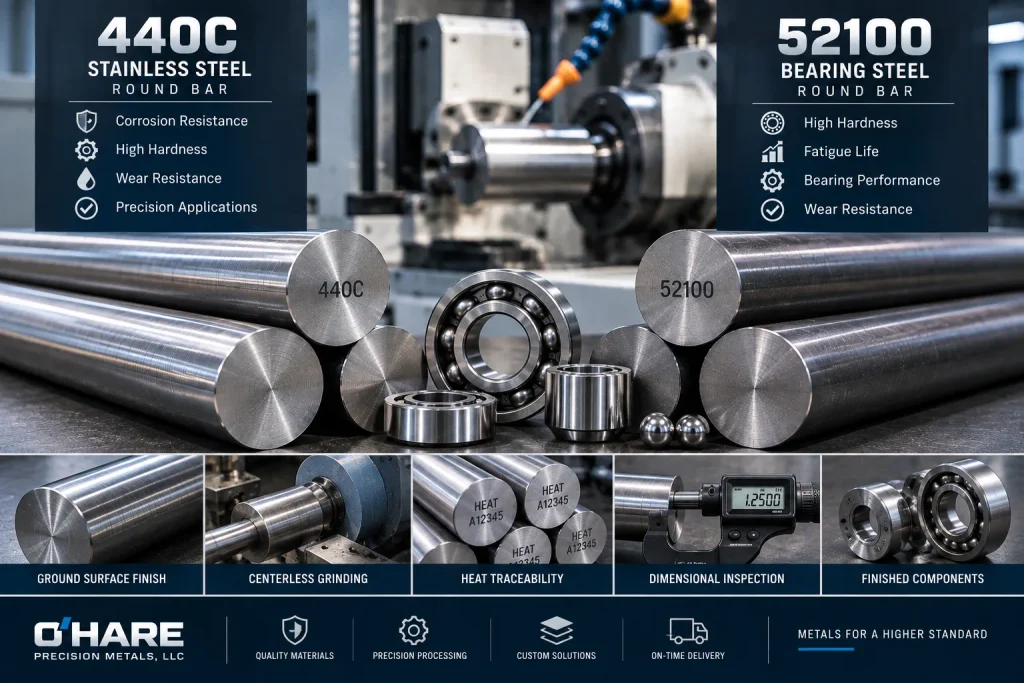
The decision between 440C stainless steel and 52100 bearing steel round bar depends on whether corrosion resistance or bearing-steel performance carries more weight. Both are high-carbon, chromium-containing steels capable of high hardness and wear resistance after suitable heat treatment. At O’Hare Precision Metals, we help buyers compare the required grade, condition, geometry, and certification before production.
440C is a martensitic stainless steel, so it offers corrosion resistance beyond conventional bearing steel while retaining hardenability. 52100 is a high-carbon chromium alloy steel developed around hardness, rolling-contact wear, and fatigue-demanding bearing applications. We supply 440C stainless steel round bar and 52100 round bar for applications with different corrosion, hardness, wear, and bearing performance requirements.
What Is the Main Metallurgical Difference?
Chromium contributes differently because the overall alloy balance and stainless classification are not the same.
440C Is a High-Carbon Martensitic Stainless Steel
440C contains enough chromium to form a stainless alloy while its carbon supports high hardness after heat treatment. It is considered for bearings, valve parts, wear components, and instruments that need a combination of hardness and moderate corrosion resistance.
Stainless Does Not Mean Immune to Corrosion
Heat treatment, surface finish, passivation, chloride concentration, temperature, crevices, deposits, and cleaning practices affect corrosion behavior. A hardened 440C component should be evaluated in its actual environment rather than described as rustproof.
52100 Is a High-Carbon Chromium Bearing Steel
52100 uses high carbon and chromium to develop hard, wear-resistant microstructures for rolling-contact applications. It is widely associated with bearing races, balls, rollers, bushings, and other components where contact stress and fatigue resistance are central.
Cleanliness and Heat Treatment Are Critical
Nonmetallic inclusions, carbide distribution, decarburization, retained austenite, grain condition, hardness uniformity, and residual stress can influence bearing performance. The grade name alone does not establish all these attributes, so the governing specification and supplier documentation matter.
How Do Hardness and Wear Resistance Compare?
Both grades can reach high hardness, but the required value must match component geometry and service.
Heat Treatment Establishes Final Hardness
Annealed bar is easier to machine before hardening. The finished component may then be austenitized, quenched, subzero treated when specified, and tempered according to the qualified route. Section size, furnace atmosphere, quench severity, tempering, and stock allowance influence distortion and final properties.
Maximum Hardness Is Not Always the Best Target
Higher hardness can improve wear resistance, but it can also reduce toughness or increase sensitivity to grinding damage if the process is not controlled. Designers should define a hardness range that supports contact stress, impact, load, lubrication, and expected failure mode.
Surface Finish Works with Hardness
Grinding marks, waviness, lobing, and burns can shorten life even when hardness meets the drawing. A surface-finish number should be paired with geometry, grinding method, inspection, and any burn-detection requirement. Centerless grinding service can provide controlled outside diameter and surface finish before downstream component processing.
How Does Corrosion Resistance Affect Selection?
Corrosion can alter both appearance and fatigue performance by creating pits that act as stress concentrators.
440C Is the Better Starting Point for Corrosive Exposure
When moisture, washdown, mild chemicals, or cleanliness requirements make conventional bearing steel difficult to protect, 440C may provide a better balance. Its resistance is lower than that of many austenitic stainless grades, so the actual fluid and cleaning chemistry must still be checked.
52100 Usually Needs Environmental Protection
52100 is not stainless and can corrode if exposed to moisture without suitable lubrication, coating, packaging, or maintenance. In a sealed, well-lubricated bearing, its contact-fatigue and wear profile may outweigh this limitation. In open or washdown service, corrosion prevention becomes part of the design.
Storage and Packaging Matter Before Assembly
Ground bar surfaces can be vulnerable during shipping and storage. The order should state acceptable corrosion protection, wrapping, desiccant, labeling, and shelf conditions. Protection must also be compatible with later cleaning, heat treatment, and assembly.
What Controls Fatigue Life in a Bearing Component?
Fatigue life is a system result, not a single property printed on a grade sheet.
Rolling-Contact Fatigue Depends on Material Quality
Hardness, case or through-hardening response, inclusion cleanliness, carbide structure, retained austenite, residual stress, and surface integrity influence crack initiation. 52100 has a long bearing-service history, while 440C may be selected when corrosion resistance justifies a different fatigue tradeoff.
Geometry and Lubrication Can Dominate the Result
Load distribution, contact stress, misalignment, edge loading, roundness, waviness, raceway finish, lubrication film, contamination, temperature, and mounting accuracy all affect life. A nominal material comparison should not be used as a direct life prediction.
Corrosion Fatigue Changes the Balance
If pits form during service, local stress can rise and initiate cracks earlier. This is where 440C’s corrosion advantage may protect fatigue performance indirectly. The benefit depends on the environment and does not remove the need for good sealing, lubrication, and maintenance.
How Should You Procure 440C or 52100 Round Bar?
A complete RFQ should define both the starting bar and the finished-part process assumptions.
State the grade and governing specification, annealed or hardened condition, nominal diameter, tolerance, straightness, surface finish, length, quantity, heat-treatment plan, hardness requirement, decarburization limit, and material-certification needs. O’Hare Precision Metals supplies both stainless steel round stock and alloy steel round bar for different corrosion, strength, wear, and machining requirements.
At O’Hare Precision Metals, we also ask whether the ordered diameter is final or includes grind and heat-treatment allowance. This avoids removing too much stock early or leaving too little for cleanup after distortion. Heat number traceability, MTRs, and any cleanliness, ultrasonic, or special inspection requirement should be stated on the purchase order.
Which Grade Should You Choose?
Choose 440C when corrosion exposure, cleanability, and high hardness must be balanced in one martensitic stainless component. Choose 52100 when a protected and lubricated system prioritizes conventional bearing-steel wear and rolling-contact fatigue performance. Validate either choice through the applicable specification, design analysis, heat-treatment route, and service testing.
We can review the bar size, condition, grinding allowance, finish, straightness, quantity, and documentation. Send the drawing and requirements through our request a quote page for a project-specific processing review.
Frequently Asked Questions
Is 440C as corrosion resistant as 304 or 316 stainless steel?
No. 440C is selected for hardenability and wear resistance with moderate corrosion resistance. Austenitic grades such as 304 or 316 generally serve different corrosion and fabrication priorities.
Can 52100 be used in wet service?
It can be used only with an appropriate corrosion-control strategy and engineering approval. Sealing, lubrication, coating, storage, maintenance, and the exact fluid determine the risk.
Should the bar be ground before or after heat treatment?
The route depends on size, distortion, stock allowance, hardness, and final tolerance. Many components are rough machined before hardening and finish ground afterward, but the process engineer should define the sequence.
Does 440C always have shorter fatigue life than 52100?
Not as a universal rule. Material cleanliness, heat treatment, hardness, geometry, finish, lubrication, corrosion, load, and testing all influence fatigue life.
What records should be ordered with bearing steel bar?
Specify the MTR, heat number, chemistry, mechanical or hardness data, condition, specification compliance, and any additional cleanliness, ultrasonic, decarburization, or inspection reports required by the application.