


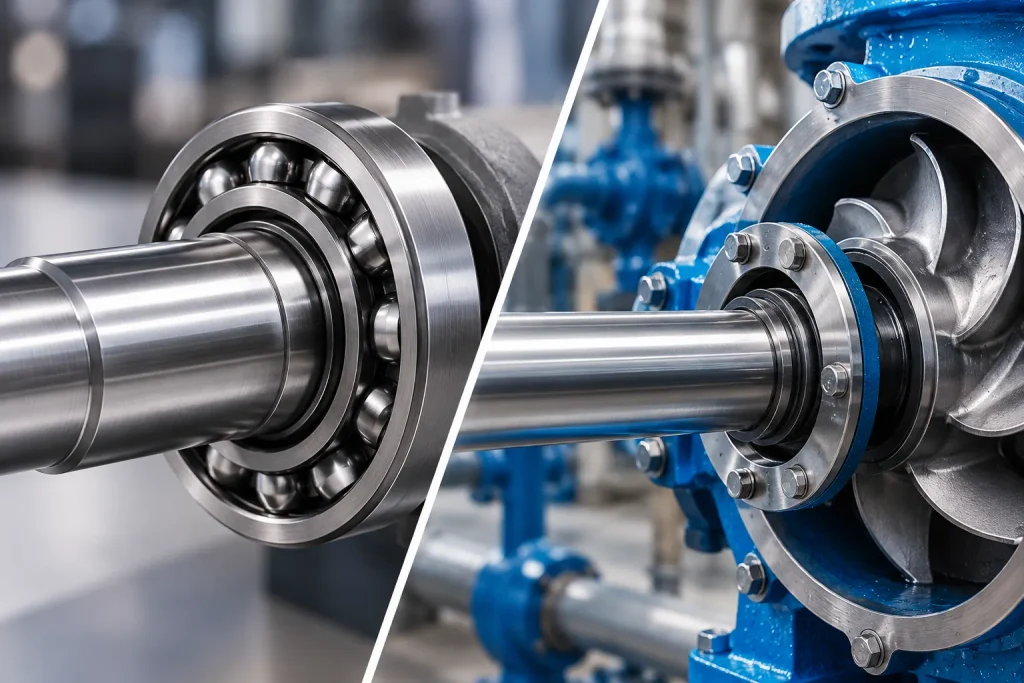
Selecting a shaft quality bar starts with the operating interface, not with a label alone. In a bearing shaft quality vs. pump shaft quality bar decision, bearing fits usually place greater emphasis on controlled diameter, roundness, and a smooth journal, while pump-shaft work makes straightness, corrosion exposure, length, and seal or sleeve interfaces especially important. At O’Hare Precision Metals, we help buyers translate the drawing into a bar specification before grinding or downstream machining begins.
Both categories describe round bar prepared for rotating equipment, but neither name replaces the print. Material grade, diameter tolerance, straightness per unit length, total indicated runout, surface-finish requirement, bar length, end condition, and inspection method still need to be stated. We supply bearing shaft quality bar and stainless shaft stock, then review the requested dimensions and processing route against the application.
What Separates Bearing Shaft Quality from Pump Shaft Quality?
The practical difference comes from where the shaft runs and which interfaces control performance.
Bearing Shaft Quality Centers on Journal Geometry
Bearing seats depend on a predictable relationship between the shaft and the bearing bore. Diameter variation can change fit, while roundness error can create uneven contact. Straightness also matters because a long shaft that bows can introduce runout even when a local diameter measurement is acceptable.
Fit Must Be Defined by the Assembly
We do not treat one universal tolerance as correct for every bearing. The bearing type, fit class, load, speed, temperature, housing arrangement, and finishing allowance determine what the drawing should require. A buyer should identify every critical journal rather than applying a demanding tolerance to the full bar without an engineering reason.
Pump Shaft Quality Adds Wet-Service and Long-Shaft Concerns
Pump shafts may pass through bearings, seals, sleeves, impellers, and couplings while operating around water or process fluids. That makes grade selection and straightness across the working length central to the specification. Our stainless steel round stock range supports projects where corrosion behavior and shaft geometry must be considered together.
Seal and Sleeve Areas Need Their Own Requirements
A seal-contact area may need a finish different from a coupling seat or threaded end. The drawing should identify each functional zone and its finish, diameter, and runout relationship. This prevents a general surface-finish note from being interpreted as the requirement for every feature.
How Tolerance, Straightness, and Finish Affect the Decision
These attributes are related, but they control different risks and should be inspected separately.
Diameter Tolerance Controls Fit and Machining Allowance
Diameter tolerance establishes the permitted size range. For finished journals, that range supports the intended bearing, sleeve, or seal fit. For bar that will be machined again, the ordered diameter also needs enough stock for cleanup without creating unnecessary removal. Our centerless grinding service can be reviewed when a project needs controlled outside diameter and a consistent cylindrical surface.
Straightness Controls Runout Potential Along the Length
Straightness describes how far the bar axis departs from a straight line. It is not the same as diameter tolerance or roundness. A short measurement can miss gradual bow across a long pump shaft, so buyers should state the gauge length, support method, and permitted deviation. Handling and packaging should also protect long finished bars from deformation after inspection.
Surface Finish Controls the Working Interface
Surface finish describes texture, not size. A smooth ground surface may support bearing journals, seals, sleeves, or later polishing, but the required Ra or RMS value must come from the drawing or equipment requirement. We confirm whether the finish applies to the complete length or only to designated functional areas.
Roundness and Runout Complete the Geometry
Roundness evaluates a cross section, while runout evaluates variation as the part rotates relative to a datum. A bar can meet diameter limits yet still fail a demanding assembly if these controls are missing. We recommend naming the datum and inspection setup whenever runout is a functional acceptance criterion.
How to Specify Shaft-Quality Bar on an RFQ
A complete RFQ lets us evaluate material, processing, inspection, and delivery as one connected requirement.
Include the grade and condition, nominal diameter, diameter tolerance, straightness requirement with gauge length, roundness or runout limit where applicable, surface finish and units, cut length and length tolerance, end treatment, quantity, certification needs, and any protected zones. If chamfered ends are needed for assembly, our bar chamfering service can be considered with the grinding route.
At O’Hare Precision Metals, we also ask which dimensions are final and which retain machining allowance. This distinction keeps the bar specification aligned with the actual manufacturing sequence. Our ISO 9001 information provides the relevant quality-system context, while project-specific inspection and documentation should be confirmed on the quotation.
Which Shaft-Quality Category Should You Choose?
Choose the category that matches the shaft’s dominant operating requirement, then define the actual attributes on the print.
Bearing shaft quality is the stronger starting point when bearing journals, controlled diameter, roundness, and smooth rotation dominate the decision. Pump shaft quality is the stronger starting point when a long shaft, wet or chemical exposure, seal areas, sleeves, and straightness across working length dominate. Many pump shafts still contain bearing journals, so the final specification may combine both sets of concerns.
We can review your grade, dimensions, finish, straightness, cut length, and documentation requirements before processing. Send the print and quantity through our request a quote page so we can evaluate the complete shaft requirement rather than relying on the category name alone.
Frequently Asked Questions
Is bearing shaft quality always held to a smaller diameter tolerance?
Not automatically. The required tolerance comes from the bearing fit, shaft design, and whether the bar is supplied at final size or with machining allowance. The RFQ should state the permitted diameter range.
Does pump shaft quality always mean stainless steel?
Stainless grades are common where corrosion exposure matters, but the correct grade depends on the fluid, temperature, strength, fabrication, and equipment requirements. Confirm the exact alloy and condition on the drawing.
Are straightness and runout the same measurement?
No. Straightness evaluates departure from a straight axis, while runout measures variation during rotation relative to a datum and setup. A print should state the intended control and inspection method.
Can centerless grinding establish the final shaft finish?
It can produce a controlled cylindrical surface, but the required finish and any later polishing depend on the application. We review the stated Ra or RMS target and the full process sequence.
What information should accompany a shaft-quality quote request?
Provide the grade, condition, diameter, tolerance, straightness, finish, length, end condition, quantity, inspection requirements, certifications, and drawing. Identify bearing, seal, sleeve, and coupling zones when they differ.