


Most bar stock headaches don’t start at the grinder. They start on the purchase order. A print calls for a tight tolerance, someone orders a grade that seems close enough, and the shop floor spends a shift chasing size or fighting a finish that won’t clean up.
At O’Hare Precision Metals, we’ve supplied precision ground and cold finished round bar since 1970, starting in Northwest Chicago and now working out of 2404 W. Hamilton Rd. in Arlington Heights. If you’re sourcing bar stock for a tight tolerance application, these are the specifications worth reviewing before you request a quote.
Choosing Precision Ground Bar Stock When the Tolerance Is the Job
Choosing the right precision ground bar starts with understanding your required dimensions, material properties, and surface finish. These specifications also help determine which grinding and secondary machining operations may be needed.
Start with the tolerance and surface finish your part actually needs
Centerless grinding is the core of what we do. The process removes material through abrasive cutting without a centering device, which makes it a strong fit for cylindrical parts that need precise concentricity and a smooth surface finish. On our ground bar, we hold tolerances up to 0.0001 inch, with a surface finish of 8 microinches or better, depending on the application.
Why does that matter to you? A bar that shows up at size and finish can reduce the amount of material your machinist removes in the next production step. That can mean fewer machining passes and less time spent bringing the material to its required dimensions. Before you ask for pricing, pull the actual tolerance and finish callouts from the print and send those numbers, not a general note that just says ground.
Pick the material family first, then narrow to a grade
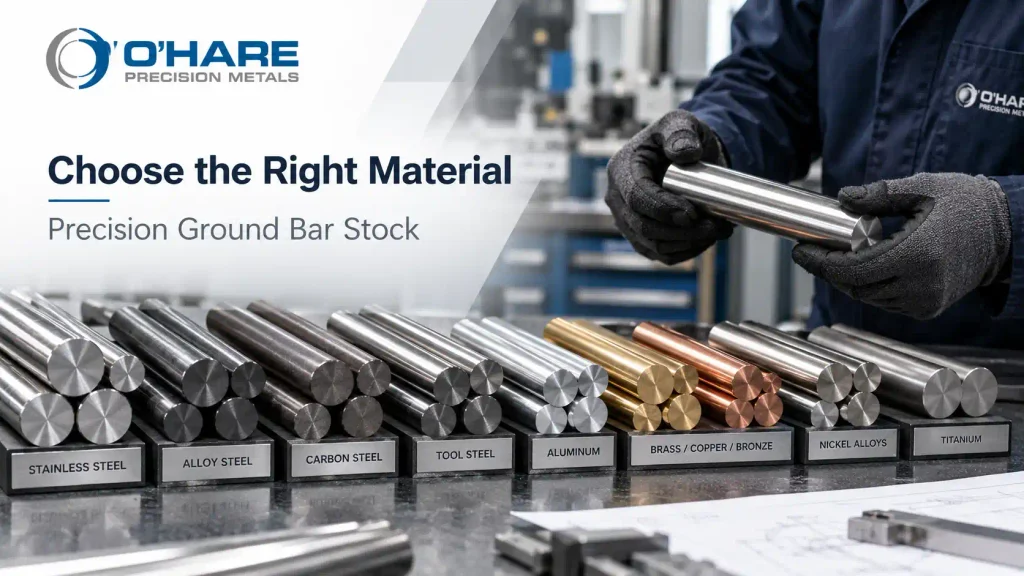
Our precision ground bar stock spans stainless steel, alloy steel, carbon steel, tool steel, aluminum, nickel and high temperature alloys, brass, copper, bronze, and titanium. That’s a wide shelf, so it helps to narrow by environment and machining plan before you get to a grade number.
On the stainless side, 303 is an austenitic grade with good machinability, used for nuts, bolts, and gears. 316 offers strong corrosion resistance and is used in pharmaceutical, marine, and medical implant applications. For carbon bar, 1045 is the most common shafting steel and is used where induction hardening is planned, while 1020 goes into hydraulic, motor, and pump shafts. 12L14 is a free machining grade used in screw machines, bushings, and hose fittings.
When a part is highly stressed, 4140 alloy is a wear resistant option. 52100 is a high carbon chromium grade used in aircraft bearings, and we also offer bearing shaft quality bar for bearing and shaft applications.
Titanium deserves its own note. It’s challenging to machine because of its high strength and low thermal conductivity, and it requires specialized tools. If titanium is on your print, plan your tooling before the bar arrives.
Size the bar for the job
Diameter and length decide whether a bar can be ground in one piece, so send both with your request. Titanium stock is available from 0.187 inches to 10.000 inches in diameter, in 10 foot and 20 foot lengths.
For tool steel round bar, finish condition belongs in the spec too. Our tool steel inventory comes annealed in DCF, ground, or rough turned finish. Tell us which one your process expects so the bar matches the next step in your shop.
Plan the operations that happen after grinding
A ground bar may still require cutting, chamfering, or machining before assembly. It helps to know which of those steps your supplier can handle.
Our automated CNC saws cut up to 7 inches in diameter using cold saw blades, and we use specialized saws for shorter bar lengths to reduce vibration during machining. Tighter cut tolerances reduce machine time downstream. We also offer CNC and manual chamfering, straightening, heat treating, turning, burnishing, custom machining, and polishing with specific Ra finishes available.
Ask how the bar is checked, not just whether it is
We’re ISO 9001:2015 certified, and quality control inspection happens at each phase of our operation. During grinding, our team controls wheel speed, feed rate, and workpiece positioning. On OD grinding work, we use in process gauging during the grinding cycle, and CNC rotary dressers let us produce intricate radii, profiles, and spherical radii.
When you’re comparing suppliers for tight tolerance work, ask where in the process size gets checked. The answer tells you a lot.
Protect the finish on the way to your dock
An 8 microinch finish only helps if it arrives that way. Our packaging options include individually wrapped tube and collar, custom wood boxes, and paper wrap in bundles, and we can package to customer preference. If your bars will sit in storage before use, mention that when you order.
What to include when you request a quote
The most useful quote requests start with complete information. Our request a quote form asks for your name, email, phone, company, referral source, and quote information. In that last field, list the material and grade, diameter, length, tolerance, surface finish, quantity, and any cutting, chamfering, or other secondary work you need.
Not sure which grade to request? Include details about your application when contacting us. We supply materials for automotive, aerospace, medical, oil and gas, and general manufacturing applications, among others.
Review your bar stock requirements
If you’re working through a tight tolerance spec right now, send it our way. Fill out our request a quote form, call us at (847) 640-6050, or email sales@ohareprecision.com. We’ve supplied round bar to manufacturers since 1970, and we’d rather help you get the spec right up front than fix it after the bar ships.
FAQs
What tolerance and surface finish can you hold on precision ground bar?
Our centerless grinding holds tolerances up to 0.0001 inch with surface finishes of 8 microinches or better, depending on the application.
Are you ISO certified?
Yes. O’Hare Precision Metals is ISO 9001:2015 certified, and we perform quality control inspections at each phase of our operation.
Can you cut, chamfer, and package bars before they ship?
Yes. We offer CNC saw cutting up to 7 inches in diameter, CNC and manual chamfering, and packaging options that include individually wrapped tube and collar, custom wood boxes, and paper wrap in bundles.