


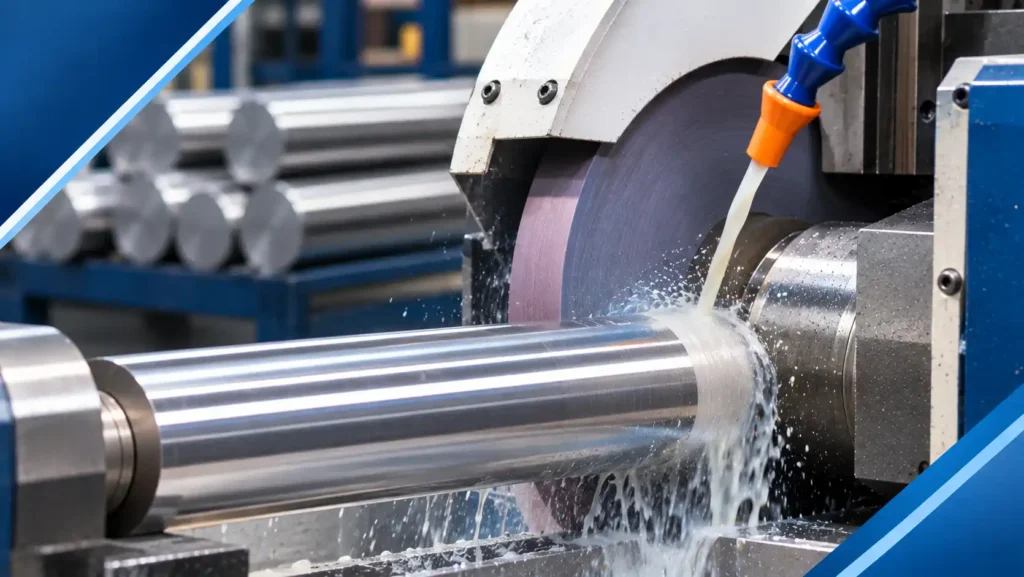
Round bar stock sounds like a simple thing to order until you start pinning down exactly what you need it to do once it reaches your shop. Will it hold its diameter consistently along the whole length? Will it run true once it is spinning in a lathe or a centerless grinder down the line? Those questions are where precision grinding comes in. At O’Hare Precision Metals, we have supplied precision ground and cold finished round steel bars since 1970, and grinding remains one of our core specialties.
What Round Bar Stock Requirements Usually Come Down To
When an engineer or a buyer talks about bar stock requirements, they are rarely just talking about a diameter and a length. They mean concentricity, a consistent surface, and a part that will behave predictably once it is clamped into a machine. Centerless grinding is built around exactly that problem. The process removes material using abrasive cutting without a centering device, which makes it well suited to cylindrical parts that need precise concentricity and a smooth surface finish. For parts that will be turned, drilled, or assembled with tight clearances, dimensional consistency can play an important role in meeting the finished part’s requirements.
Where Precision Grinding Fits Into the Process
The grinding cycle itself is managed through wheel speed, feed rate, and workpiece positioning, and those controls are what let us hold tight tolerances across different metals and alloys rather than just one. Precision grinding helps bring round bar stock closer to its specified diameter, concentricity, and surface finish requirements. This matters during production when individual pieces need to meet the same dimensional specifications.
Tolerance and Surface Finish, by the Numbers
Specifications matter here, so it is worth being direct about them. Our grinding capabilities include tolerances as tight as 0.0001 inches and surface finishes of 8 microinches or better, depending on the material and processing requirements. Our grinding capabilities include work up to 9 inches in diameter and 50 feet in length. Our specialized grinding division also handles work up to 7 inches in diameter and 24 feet in length. The applicable capacity depends on the job requirements. We also run in feed and thru feed grinding, which gives us flexibility depending on the part geometry and the volume of the order. If your project calls for a specific tolerance band, that is exactly the kind of detail worth sharing with us before the job starts rather than after.
The Material Range Behind This Capability
Precision grinding only solves half the problem if the material itself is not right for your application. We supply a wide range of materials, including stainless steels, alloy steels, carbon steels, tool steels, aluminum, nickel and high temperature alloys, titanium, medical grade stainless steel, brass, copper, and bronze. That range matters because a grinding setup for a stainless bar is not the same as one for an aluminum bar, and the specific material grade helps determine the grinding requirements for your project. Having access to both round bar stock and precision grinding services gives you a practical starting point when specifying material and dimensional requirements.
Quality Control and Why Repeat Orders Depend on It
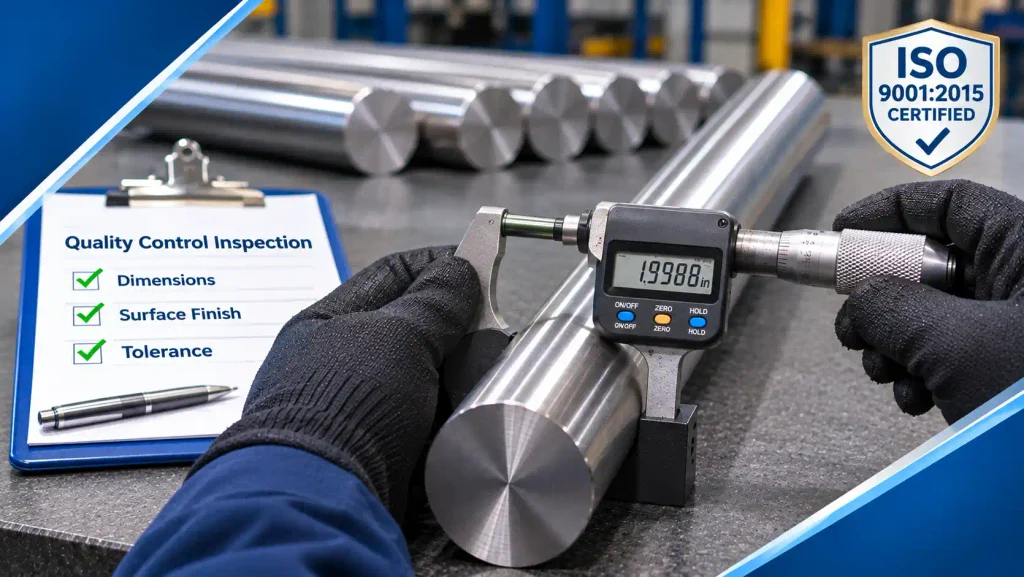
A single ground bar that hits tolerance is one thing. Meeting dimensional requirements across a production run calls for consistent attention to quality control. We perform inspections at each phase of operation to monitor our work against the required specifications. We are ISO 9001:2015 certified, reflecting our commitment to established quality management practices. For repeat orders, consistent dimensions and surface finish are important reasons to specify precision ground stock instead of mill finish bar.
Industries That Depend on Precision Ground Round Bar
Our grinding work supports customers across automotive, aerospace, military and defense, construction, mining, medical, and chemical processing industries. Each of those fields has its own reasons for needing dimensional consistency, whether that is a part that has to seat correctly in an assembly or one that has to survive repeated machining operations without drifting out of spec. Across these industries, consistent dimensions and surface quality can help manufacturers meet the requirements of their machining and assembly processes.
Conclusion
If you are specifying round bar stock and trying to figure out whether precision grinding is the right call for your tolerance and finish requirements, we would rather talk through the specifics with you than have you guess. Call O’Hare Precision Metals at (847) 640-6050, email sales@ohareprecision.com, or submit your details through our Request a Quote page, and we will help you match the grinding capability to what your project actually needs.
FAQs
What does precision grinding actually improve on round bar stock?
Centerless grinding is used to achieve precise concentricity and a smooth surface finish on cylindrical parts, which supports the dimensional consistency many machining and assembly processes need.
How tight a tolerance can O’Hare Precision Metals hold?
Our grinding capabilities include tolerances as tight as 0.0001 inches and surface finishes of 8 microinches or better, depending on the material and processing requirements.
What size bar stock can be ground?
Our grinding capabilities include work up to 9 inches in diameter and 50 feet in length. Our specialized grinding division also handles work up to 7 inches in diameter and 24 feet in length. The applicable capacity depends on the job requirements.
Is O’Hare Precision Metals certified for quality management?
Yes. We are ISO 9001:2015 certified, and we perform quality control inspection at each phase of operation.