


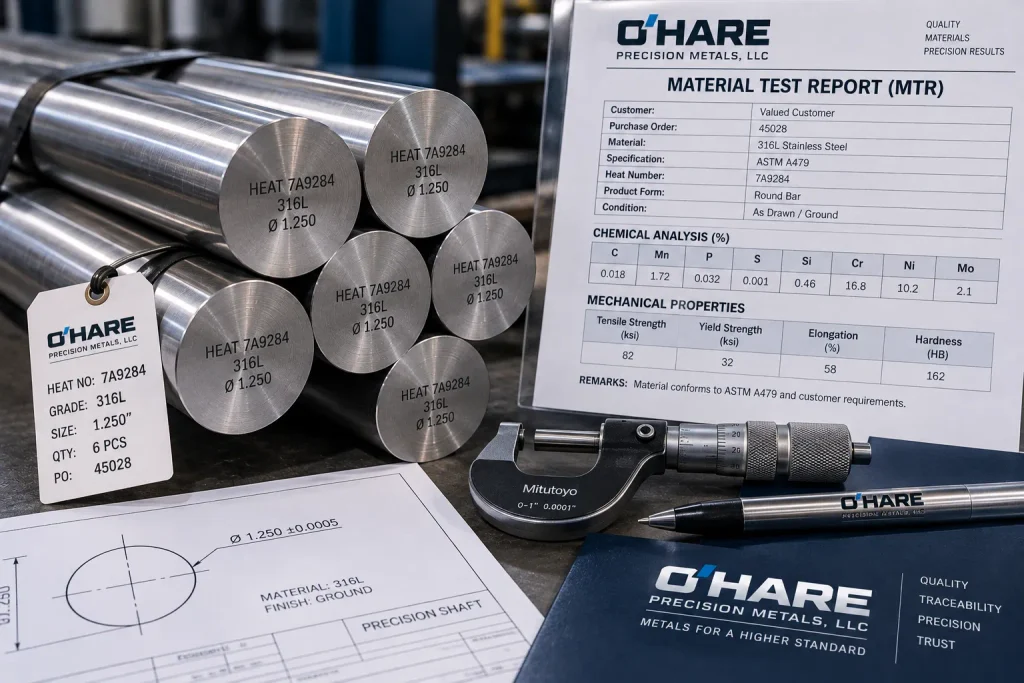
Material certifications for precision ground bar stock should connect the delivered bar to its specified grade, heat, condition, and ordered test results. An MTR can report chemistry and mechanical properties, a heat number can connect the document to the material, and traceability controls preserve that relationship through grinding, cutting, packaging, and receiving. At O’Hare Precision Metals, we ask buyers to state documentation requirements before processing so the correct records can remain connected to the order.
A certificate package should match the risk and purchase specification. Some commercial jobs need a basic material certification, while regulated, safety-critical, aerospace, medical, energy, or customer-controlled work may require the original mill report, full heat traceability, special-process records, inspection results, or additional testing. We supply precision ground bar stock across stainless steel, carbon steel, alloy steel, aluminum, nickel alloys, titanium, and other material families.
What Is an MTR and What Should It Show?
An MTR, also called a mill test report or material test report, is a lot-specific record used to demonstrate reported material characteristics.
Identity Fields Connect the Report to the Bar
The report should identify the producing mill or reporting organization, material grade, applicable specification and revision when shown, product form, heat or melt number, size, and condition. These fields let receiving personnel compare the document with the purchase order and bar tags.
A Grade Name Alone Is Not Sufficient
A line that says only 316 stainless, 4140 alloy steel, or nickel alloy does not show the exact specification, condition, or heat. Buyers should check whether suffixes, UNS numbers, heat-treatment states, and product-form requirements match the drawing.
Chemistry Confirms the Reported Alloy Composition
The MTR commonly lists heat analysis values for controlled elements and compares them with specification limits. Reviewers should verify the correct units, limits, and reporting basis. Product analysis, when separately required, should not be confused with the original heat analysis.
Mechanical Results Confirm the Tested Condition
Depending on the specification, the report may include tensile strength, yield strength, elongation, reduction of area, hardness, impact results, or other tests. A value is meaningful only when its test direction, specimen location, size, condition, and acceptance limit correspond to the order.
Why Does the Heat Number Matter?
The heat number is the primary identifier that connects a batch of metal to its production and test record.
Heat Traceability Supports Document Matching
When the bar tag, packing record, and MTR carry the same heat number, a receiving team can confirm that the paperwork belongs to the delivered material. If several heats are supplied, each heat should be identifiable and supported by the corresponding report.
Processing Can Divide One Heat into Many Pieces
Centerless grinding, sawing, straightening, chamfering, and packaging may convert long mill bars into smaller finished pieces. The traceability plan should define how identity is retained after original markings are removed. Our centerless grinding service can be quoted together with the required identification and documentation controls.
Piece Marking Is Not Always the Required Method
Traceability may be maintained by individual marking, tagged bundles, segregated containers, job travelers, or controlled packaging, depending on the order. The customer should state whether every piece must be marked and which marking method is acceptable for the material and finish.
Which Additional Certifications Might Be Required?
Additional documents should be requested only when they support a real specification, risk, or customer requirement.
Certificate of Conformance
A certificate of conformance states that the supplied item conforms to identified purchase-order requirements. It is not automatically a substitute for an MTR because it may not contain actual chemistry or mechanical test values.
Heat-Treatment and Special-Process Records
Orders may require records for annealing, solution treatment, aging, quenching and tempering, stress relieving, passivation, coating, or another process. The document should identify the process, applicable procedure or specification, lot, date, and acceptance result where required.
Inspection and Test Reports
Dimensional inspection, straightness, roundness, surface finish, hardness, ultrasonic testing, penetrant testing, magnetic-particle testing, or positive material identification may be ordered. These are separate evidence streams. An MTR does not automatically prove that the finished ground diameter or surface finish was inspected.
Country-of-Origin and Regulatory Declarations
Some contracts require country-of-melt, country-of-origin, DFARS, domestic-content, conflict-minerals, RoHS, REACH, or other declarations. Requirements vary and should never be inferred from an ISO certificate or general company statement. Provide the exact clause and revision during quotation.
How Should Receiving Inspect the Certification Package?
Receiving should verify documents and physical identity before tags or packaging are discarded.
First, compare the purchase order, packing list, MTR, certificate of conformance, and bar tags. Confirm grade, specification, condition, diameter, length, quantity, and heat numbers. Next, review chemistry and mechanical results against the correct limits. Finally, confirm that ordered inspection reports and special-process certificates are present and refer to the correct lot.
O’Hare Precision Metals is ISO 9001:2015 certified. It does not replace lot-specific material evidence. Buyers should treat the ISO certificate, MTR, traceability record, and dimensional inspection report as different documents with different purposes.
How to Specify Documentation on the RFQ
Clear documentation language prevents gaps that cannot be repaired easily after bars have been cut or mixed.
State whether reports must be originals, unaltered copies, or supplier-certified copies; whether full or partial heat traceability is required; whether each piece or bundle needs identification; which test results must appear; whether electronic records are acceptable; and how long records must be retained. Include any customer forms or flow-down clauses with the RFQ.
At O’Hare Precision Metals, we can review material, grinding, cut length, finish, packaging, and documentation as one scope. We also provide packaging options designed to protect processed bar during shipment. Contact O’Hare Precision Metals with questions about material, processing, or quote requirements. Submit your material, dimensions, quantity, processing requirements, and any required documentation when you request a quote.
Frequently Asked Questions
Is an MTR the same as a certificate of conformance?
No. An MTR normally reports material identity and test values, while a certificate of conformance states compliance with specified order requirements. A job may require one or both.
Can several heat numbers appear on one shipment?
Yes. If multiple heats are supplied, each bar or controlled bundle should remain identifiable and each heat should have the corresponding documentation required by the order.
Does ISO 9001 certification prove the alloy grade?
No. ISO 9001 addresses the quality management system. The MTR, heat number, identification, and any ordered verification tests provide lot-specific material evidence.
Should every cut piece carry a heat number?
Only if the order or governing specification requires piece-level marking. Other controlled methods may be acceptable, but the traceability level and marking method should be agreed before processing.