


The better choice in a Monel vs. Hastelloy round bar comparison depends on the corrosive medium, concentration, temperature, pressure, velocity, aeration, and applied stress. Monel nickel-copper alloys are often considered for seawater and marine service, while Hastelloy nickel-based grades are widely used in aggressive chemical-processing environments. At O’Hare Precision Metals, we help buyers turn those broad families into a specific grade, bar condition, diameter, finish, and documentation requirement.
Family names are not enough for final selection. Monel 400 and K-500 do not have the same strength or heat-treatment response, and Hastelloy C-22 and C-276 do not have identical corrosion profiles. We supply Monel bar stock and Hastelloy bar for applications with different corrosion and mechanical requirements.
What Fundamentally Separates Monel and Hastelloy?
Their alloy systems create different strengths, corrosion envelopes, and fabrication considerations.
Monel Is a Nickel-Copper Alloy Family
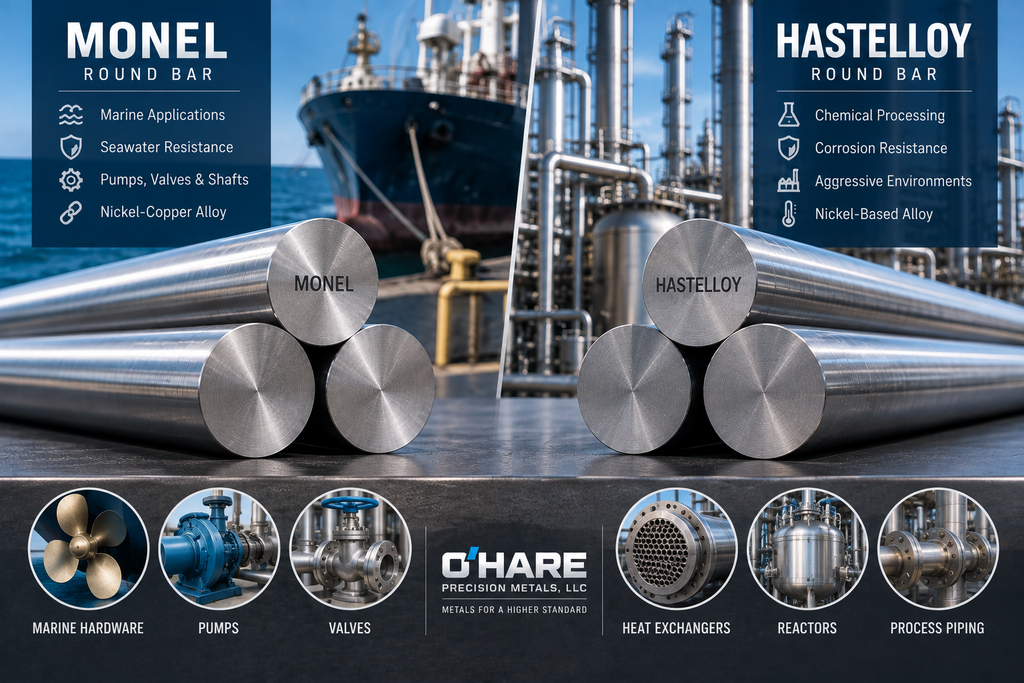
Monel alloys use nickel and copper as principal elements, with grade-specific additions and limits. This family is associated with resistance in seawater and selected reducing environments. It is used in marine hardware, pumps, valves, shafts, and processing equipment when the chosen grade matches the fluid and mechanical demand.
Monel 400 and K-500 Serve Different Strength Needs
Monel 400 is a solid-solution alloy, while K-500 adds age-hardening capability for higher strength. That difference affects condition, heat treatment, machinability, magnetic response, and stress-corrosion considerations. The RFQ should never use only the word Monel when strength or treatment is critical.
Hastelloy Covers Several Nickel-Based Corrosion Alloys
Hastelloy grades commonly use chromium and molybdenum, with chemistry tailored for aggressive acids, oxidizing or reducing conditions, pitting, and crevice-corrosion resistance. We also supply Hastelloy C-22 round bar and Hastelloy C-276 round bar.
Grade Selection Must Follow the Chemical Environment
C-22 and C-276 can overlap in some applications, but a general family comparison cannot establish compatibility. Chemical species, concentration, impurities, temperature, process upsets, crevices, welds, and cleaning agents should be evaluated with reliable corrosion data.
Which Family Fits Marine Service Better?
Marine selection should separate general seawater exposure from high-strength, stagnant, high-velocity, or galvanically coupled conditions.
Monel Often Provides a Direct Marine Starting Point
Monel is widely associated with seawater-handling equipment, marine fasteners, valve parts, propeller-related components, and pump hardware. Its nickel-copper base can be useful where seawater resistance is required, but biofouling, erosion-corrosion, velocity, sulfides, oxygen level, and galvanic couples can change results.
Hastelloy May Be Needed When Marine Exposure Includes Aggressive Chemicals
Offshore or coastal processing equipment may see chlorides together with acids, sour media, high temperature, or chemical cleaning. In that case, a suitable Hastelloy grade may offer a broader corrosion envelope. The answer should come from the combined process stream, not from the word marine alone.
Strength and Shaft Geometry Still Control Rotating Parts
For pump shafts and rotating equipment, corrosion resistance must be paired with yield strength, fatigue behavior, straightness, diameter tolerance, surface finish, and coupling design. A high-corrosion alloy that does not meet the mechanical or dimensional requirement is not a complete solution.
Which Family Fits Chemical Processing Better?
Chemical-processing selection is usually more grade-specific because small changes in chemistry and temperature can alter corrosion behavior.
Hastelloy Is Common for Severe Process Media
Hastelloy bars are used in chemical-processing components such as valves, pumps, shafts, fasteners, reactor equipment, and heat-exchanger hardware. Grades are selected for particular combinations of oxidizing and reducing acids, chlorides, localized corrosion, and elevated temperature.
Monel Can Be Effective in Selected Reducing or Caustic Services
Monel may be appropriate for certain alkalis, hydrofluoric-acid conditions, brines, and reducing environments, depending on grade and service details. It should not be described as universally resistant to acids or chemicals. Compatibility data for the exact composition and operating range is essential.
Welded Areas Require Separate Attention
Weld filler, heat input, dilution, cleaning, oxide removal, and crevice geometry can change local performance. If the bar will be welded into a process assembly, specify the welding procedure and any corrosion testing or examination required by the code.
How Do Machining and Grinding Affect Procurement?
Nickel alloys can work harden and retain heat at the cutting zone, so the production route should be planned before ordering finished diameter.
Rigid machines, sharp tooling, positive cuts, stable feed, suitable coolant, and controlled interruptions help manage machining. For round bar requiring a controlled outside diameter, centerless grinding service can be specified when controlled outside diameter and surface finish are required.
At O’Hare Precision Metals, we also distinguish surface texture from corrosion condition. A specified Ra value does not by itself establish cleanliness, passivation, contamination control, or freedom from heat tint. State each acceptance requirement independently.
How to Make the Final Alloy Decision
Start with a corrosion table or engineering evaluation for the exact fluid, then compare mechanical properties, temperature capability, fabrication, availability, and lifecycle risk.
Your RFQ should state the exact alloy and UNS designation, specification, condition, diameter, tolerance, straightness, finish, cut length, quantity, heat treatment, MTR, heat-number traceability, and any PMI, ultrasonic, penetrant, or corrosion-test requirement. Our nickel bar stock selection includes multiple alloys for corrosion, strength, and high temperature requirements.
We can review bar processing and documentation against your print. Submit the grade, dimensions, quantity, and processing requirements to request a quote.
Frequently Asked Questions
Is Monel always the better alloy for seawater?
No. Monel is a strong starting family for many seawater applications, but velocity, aeration, sulfides, galvanic coupling, strength, temperature, and equipment geometry can change the selection.
Is Hastelloy one specific grade?
No. Hastelloy is a family of nickel-based alloys. The purchase order should identify the exact grade, UNS designation, specification, and condition.
Can Monel and Hastelloy be machined like stainless steel?
Not exactly. Many nickel alloys work harden and concentrate heat at the cutting zone. Tooling, rigidity, feed, speed, coolant, and operation sequence should be selected for the exact grade.
Does a smooth finish guarantee corrosion resistance?
No. Finish can influence cleanability and local initiation sites, but alloy compatibility, contamination, fabrication, crevices, stress, temperature, and fluid chemistry remain critical.
What documentation should accompany nickel-alloy bar?
Common requirements include an MTR, heat number, chemistry, mechanical properties, heat-treatment condition, specification compliance, and any ordered PMI or special test reports. State each requirement on the purchase order.