


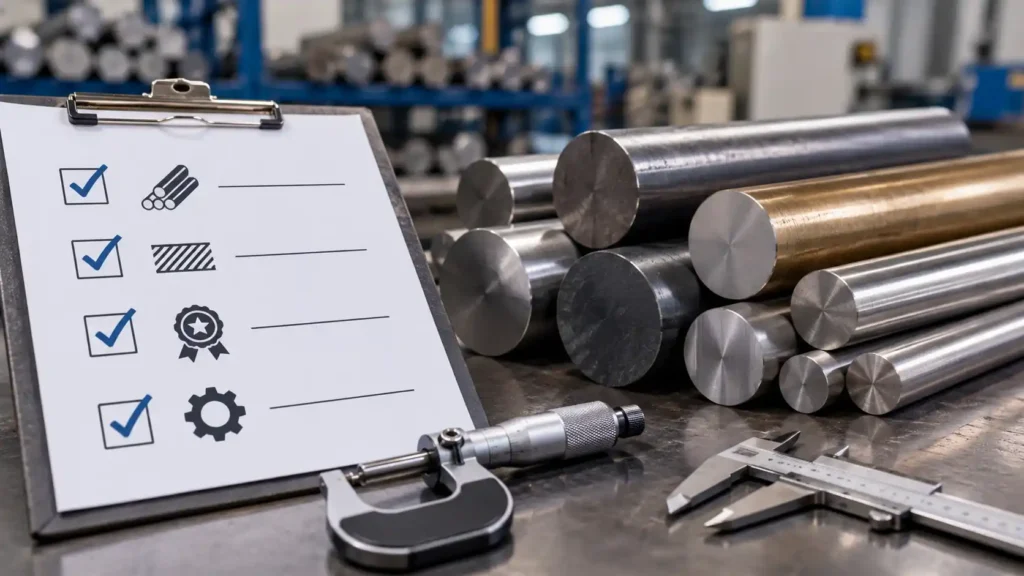
A tool steel order usually starts with a grade number on a print. That number is only the first line of the order, though. The finish condition, the cut size, and the quality system behind the bar all decide whether the stock is ready for your shop the day it lands.
At O’Hare Precision Metals, we’ve supplied round bar from the Chicago area since 1970, and tool steel is one of the material families we stock. If you’re comparing tool steel suppliers for a toolroom or production order, these are the details worth checking before you commit.
A Practical Checklist for Choosing a Tool Steel Supplier
Choosing a tool steel supplier involves more than identifying the required grade. Finish condition, stock dimensions, processing capabilities, and quality control all affect how the material fits your manufacturing requirements.
Match the grade family to the job the tool will do
Start with what the tool has to survive. For cold work and wear, our grade list includes A2, a medium air hardening steel used for slitters and die shapes, and A10, which offers minimum distortion on hardening and goes into thread rolling dies. D2 is a high chromium, high carbon grade that’s highly wear resistant, used for blanking and forming dies. D3 brings high wear resistance to draw dies and powder metal tooling.
Hot work is a different problem. H13 resists softening at high temperatures and is used in die casting and extrusion dies. H11 is a chromium hot work steel used in aircraft landing gear. For molds, P20 is a mold steel used for injection molds and die casting dies.
Then there are the shop floor workhorses. S7 is a shock resistant grade for high impact tools. O1 is oil hardening and used for precision tools, while O6 is a graphitic oil hardening tool steel. W1 is a simple, water hardening high carbon steel used for metal cutting, embossing, taps, and cutlery. M2 is a high speed tool steel valued for wear resistance in cutting tool applications.
Check the supplier’s range of tool steel grades
One grade on one job is easy. The harder question is whether the same tool steel supplier can cover the next five jobs. Our tool steel inventory runs as round bars, annealed, in A10, A11, A2, A6, A7, A8, A9, D2, D3, D7, H11, H13, L6, M2, M3, M4, M50, M7, O1, O2, O6, P20, S1, S5, S7, W1, W2, T1, T15, and Viscount 44.
That matters for purchasing. Working with a supplier that carries multiple tool steel grades can simplify sourcing across different jobs. When material requirements change, you can check grade availability with an existing supplier before approaching another one.
Decide on the finish condition before you ask for pricing
Every grade in that inventory is available in DCF (decarb free), ground, or rough turned finish. Those three options look like a footnote on a quote, but they describe different starting points for your shop. Pick the one your next operation expects and put it on the request. If you’re unsure which condition your toolmaker wants, ask them before the order goes out.
Ask about custom cuts and sizes
Some tool steel orders call for cut lengths rather than full bars. Custom cuts and sizes are available on our tool steel, and our automated CNC saws cut up to 7 inches in diameter using cold saw blades. Tighter cut tolerances can reduce additional machining time, and we use specialized saws for shorter bar lengths to reduce vibration during machining. Cut blanks supplied closer to the required dimensions may reduce the cutting work needed in your toolroom.
Check the supplier’s quality control practices
We’re ISO 9001:2015 certified, and quality control inspection happens at each phase of our operation. During grinding, our team controls wheel speed, feed rate, and workpiece positioning. When comparing suppliers, ask how quality is checked throughout processing.
Plan the work that happens after the bar is cut
Some tool steel orders need more than a cut blank. We also handle straightening, turning, chamfering, heat treating, parts machining, and CNC milling. Packaging options include individually wrapped tube and collar, custom wood boxes, and paper wrap in bundles, so a ground surface can be protected in transit.
What to send with your quote request
Tool steel pricing comes through a quote. Our request a quote form asks for your name, email, phone, company, referral source, and quote information. In that last field, list the grade, finish condition, diameter, cut length, quantity, and any tolerance or secondary work you need.
Let’s talk through your next tool steel order
If you’re lining up stock for a die, a mold, or a run of cutting tools, send us the grade and finish you have in mind. Use our request a quote form, call O’Hare Precision Metals at (847) 640-6050, or email sales@ohareprecision.com.
FAQs
Which tool steel grades do you carry?
Our tool steel range includes grades such as A2, D2, H13, M2, O1, S7, and W1, along with additional grades available as annealed round bars. Contact us with the grade you need to confirm availability.
What finish conditions are available?
Every grade in our tool steel inventory is available in DCF (decarb free), ground, or rough turned finish. Put the finish you need on your quote request.
Can you cut tool steel to size?
Yes. We offer custom cuts and sizes, and our automated CNC saws cut up to 7 inches in diameter using cold saw blades.
How do I get pricing on tool steel?
Tool steel pricing is provided by quote. Use our request a quote form, call (847) 640-6050, or email sales@ohareprecision.com with the grade, finish, size, and quantity you need.
